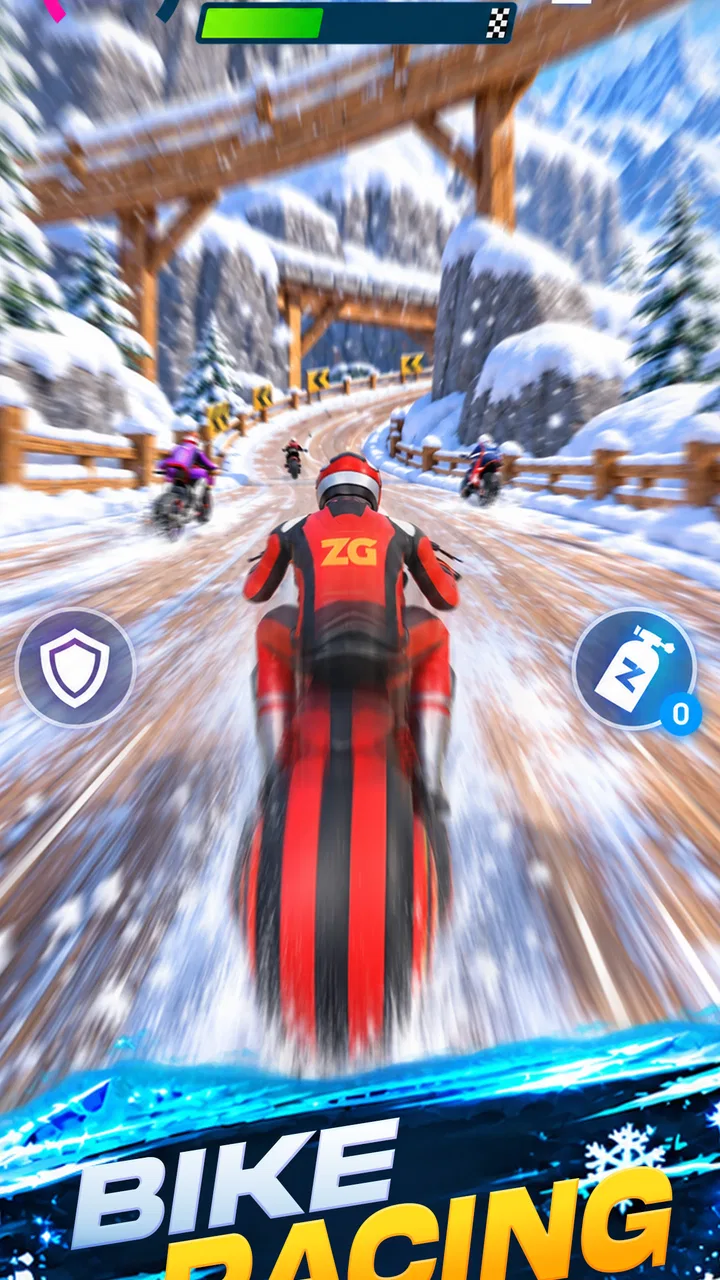
Bike Race: Racing Games
- 4.5
- Rating
- 100.00M
- Installs
- Free
- Price

 Analysis by App-foxy
Bike Race is the kind of motorcycle game I can open for a quick break and understand almost immediately. It belongs to the racing category, but its appeal is not built around long circuits or realistic driving. The focus is on short, energetic rides where control, timing, stunts, and recovery matter more than learning a complicated garage system. I found that simplicity useful: I can start playing without a long tutorial, yet the tracks still ask for enough attention to keep a casual session from feeling completely automatic.
Developed by iKame Games - Zego Studio, the game is free and suitable for Everyone. It has reached over 50 million installs and holds a 4.5 average from around 124 thousand ratings, which gives a good indication of how widely this compact style of racing has connected with mobile players. It was released on March 24, 2023, and the current version is 1.148. The game supports Android 7.0 and later, so it is aimed at a broad range of phones rather than only recent flagship hardware.
How the first ride sets the tone
My first impression was that the game wants me to act rather than study. The motorcycle moves through a track filled with changes in height, jumps, obstacles, and moments that reward a well-timed stunt. Instead of presenting racing as a simulation, it turns each section into a small physical puzzle. I am constantly deciding whether to keep the bike stable, lift the front wheel, rotate in the air, or prepare for a landing.
You May Also Like

 Blood Strike: 2.5 Anniversary
Blood Strike’s Loadouts Turn Every Drop Into a Tactical Gamble
A close look at Blood Strike’s custom loadouts: how fast access to signature weapons reshapes its battle royale rhythm, rewards preparation, and narrows the gap between fights.

 Pandora - Music & Podcasts
Pandora’s Music Is Easy to Start, but Harder to Recover
Pandora’s strength is its low-effort path from a seed to a station. Its weak spot is how much confidence it asks you to place in connection, setup, and quiet recovery.

 8 Ball Pool
 Is Built on Rivalries, Rematches, and Routine
A close look at the rivalries, rematches, shared routines, and unanswered safety questions that turn a quick pool match into a persistent mobile community.

 Samsung Music
’s Quiet Strength Is Playing What You Already Own
Its reach comes less from spectacle than from dependable access to a personal library. That simplicity is both the app’s strongest retention engine and its ceiling.

 AccuWeather: Weather Radar
AccuWeather Review: A Quick, Clear Forecast for Everyday Decisions
For everyday plans, the best forecast is the one you can understand quickly. AccuWeather makes rain timing, radar, and local conditions easy to act on, with a few trade-offs.

 Hill Climb Racing
Why Hill Climb Racing Still Turns Crashes Into One More Run
A tiny car, a bumpy hill and one more upgrade: Hill Climb Racing keeps resurfacing because its simple chaos makes every near-miss feel personal.
More From Our News Desk
View All News


That design makes the opening minutes approachable. A player who has never touched a motorcycle game can understand the basic goal quickly: reach the finish while keeping control. At the same time, the movement has enough sensitivity to make mistakes feel personal. If I land badly, the problem usually comes from a late adjustment or poor timing rather than from a confusing menu or an elaborate control scheme.
The strongest early quality is pacing. Races do not require the commitment of a long console-style event, so the game fits naturally into a short wait, a commute break, or a few minutes before bed. I would not choose it when I want a deep career mode or a realistic racing weekend. I would choose it when I want repeated attempts at a focused challenge, with the satisfaction of improving through small corrections.
The free entry point also matters. I can try the core experience without paying first, which makes it easy to recommend to someone who likes quick arcade racing but is unsure about motorcycle games. The Everyone age rating reinforces that accessible presentation. Still, “easy to begin” should not be confused with “effortless to master.” The later enjoyment comes from learning how the bike behaves over different jumps and from recognizing when speed is helpful and when it makes a landing harder to control.
A visual language built around motion
The art direction works because it keeps the motorcycle and the track readable. I do not need a highly detailed landscape to understand what deserves my attention. The important visual information is the shape of the route, the next change in elevation, and the space available for a landing. This gives the game a clean arcade identity instead of pretending to be a photographic motorbike simulator.
That visual clarity also supports the mood. The setting feels designed for movement: ramps, uneven surfaces, and airborne moments turn the screen into a sequence of visual prompts. A successful ride has a pleasing flow because the track appears to speak in shapes. A steep rise suggests a jump, an open gap invites a stunt, and a difficult landing warns me to stop showing off. The world is not there mainly for sightseeing; it is a readable stage for physical decisions.
One useful habit I developed was looking slightly ahead rather than staring at the front wheel. The bike reacts quickly, and focusing only on the immediate ground makes it easy to miss the next transition. Watching the upcoming slope helps me choose whether to accelerate, release control, or prepare for rotation. This is a small adjustment, but it changes the game from frantic tapping into a more deliberate rhythm.
The visual style is also a reason to avoid comparing this directly with realistic racing alternatives. A simulation may offer licensed machines, detailed environments, and a stronger sense of speed through visual effects. Here, the attraction is the clarity of the challenge. I can see the relationship between my input and the result more clearly, which is valuable when I am replaying a section to improve rather than simply trying to admire the scenery.
Sound that supports short bursts of concentration
The audio contributes to the game’s compact arcade mood. I experience the ride as a sequence of acceleration, jump, adjustment, and landing, and the sound helps those moments feel connected. It is not the kind of soundtrack or sound design I would approach as a separate entertainment feature. Its job is to keep the action moving and give the ride a little more energy.
That restraint suits the format. Because a session can be brief, an overly dramatic presentation would become tiring quickly. The game benefits from a soundscape that stays behind the controls instead of competing with them. When I am concentrating on a difficult landing, I want the audio to reinforce the rhythm rather than bury the visual cues.
I also found that the game’s mood changes according to my own performance. A smooth run feels almost musical because the actions arrive in a regular sequence. A failed jump breaks that rhythm immediately, but restarting gives me a clear chance to try the same passage with a different approach. This is where sound and mechanics meet: the atmosphere feels lively when I am in control, while mistakes create a useful pause rather than a confusing collapse.
Players who expect a large narrative world or a cinematic soundtrack may find the presentation modest. That is a fair limitation, but it is not a serious flaw for the game’s purpose. The audio supports repeated attempts, and repeated attempts are the heart of the experience. I would keep the volume at a level where I can still focus on the track, especially during longer sessions.
Why the mechanics fit the mobile format
The control design is most successful when I treat each ride as a chain of small commitments. I am not merely holding a direction until the finish. I am managing the bike’s balance through changes in terrain, then deciding how much aerial movement is worth the risk. This gives the game a satisfying middle ground between a reflex game and a physics challenge.
My most reliable approach is to stop chasing spectacular stunts when the landing zone is narrow. A rotation can look impressive, but a clean landing usually matters more than an ambitious trick that leaves the motorcycle unstable. This trade-off is one of the game’s better sources of tension. It lets me play safely when I only want to clear a track, or take greater risks when I am replaying for personal improvement.
Another practical tip is to separate acceleration decisions from stunt decisions. When I try to do both at once without watching the bike’s position, I often create a problem that began several seconds earlier. I get better results by building enough momentum on the approach, then concentrating on the bike’s angle during the jump. That workflow makes the controls feel less chaotic and reveals more of the game’s timing.
The short-track structure is especially useful for everyday play. Imagine having five minutes before an appointment: I can attempt a route, fail at one landing, and immediately understand what I want to change on the next try. The game does not demand that I remember a large map or manage a long race strategy. Its challenge is local and repeatable, which makes progress feel noticeable even when I only have time for a handful of attempts.
There is friction, though. Players who dislike restarting after a single mistake may find the emphasis on precision irritating. The game’s appeal depends on accepting failure as part of the loop. It also may not satisfy someone who wants direct competition against a large field of opponents, realistic overtaking, or detailed vehicle tuning. Compared with conventional circuit racers, this is closer to a stunt-focused obstacle ride than a full racing career.
Who will enjoy it and who should look elsewhere
I think the best audience is someone who enjoys arcade racing with a physical twist. If you like learning a short section through repetition, adjusting your timing, and turning a failed jump into a successful one, the game has a clear purpose. It also works well for players who want a motorcycle theme without committing to simulation controls or a lengthy progression system.
It is less suitable for a player whose priority is realism. The game’s identity comes from exaggerated track design and stunt-friendly movement, not from reproducing the weight and handling of a real motorcycle. Someone looking for detailed machine customization, deep race strategy, or a story-driven campaign would probably be happier with a different type of racing game.
I would also be cautious about recommending it to anyone who wants every session to feel new without replaying familiar challenges. The satisfaction here comes from refining execution. The same kind of track can remain interesting when I am trying to improve my landing, but that loop will feel repetitive if I do not enjoy practicing. The free price makes experimenting easy, yet it does not change the fundamental nature of the game.
For families, the Everyone rating makes the presentation broadly approachable. I would still explain to younger players that the game rewards patience more than simply pressing faster. A child may enjoy the jumps immediately, while the more demanding part is learning to control the motorcycle after leaving the ramp. That creates a useful, low-pressure introduction to timing-based play.
Practical expectations before downloading
The game is free, and that makes the decision straightforward: it is worth trying if the idea of quick motorcycle challenges appeals to you. I would install it on a compatible Android device running version 7.0 or later and begin with short sessions rather than expecting a full-length racing experience. The current version is 1.148, so checking that the installed build is current is sensible before judging how it feels.
The large install base and strong average rating suggest that the format has broad appeal, but popularity should not replace personal fit. I would base the decision on the kind of racing I want today. If I want immediate action, readable obstacles, and a reason to replay a tricky jump, this is a good match. If I want a realistic garage, long races, or a packed competitive field, I would choose another category of racer instead.
One of the more useful ways to play is to give each attempt a single goal. I might focus on landing without rotating, then on carrying more speed through the next section, and only later on combining speed with a stunt. This prevents random retries from becoming frustrating. It also helps me identify whether a failure comes from the approach, the airborne angle, or the landing itself.
I would not judge the game solely by its first easy rides. The opening is designed to make the controls understandable, while the lasting appeal comes from how much attention I give to the track’s rhythm. Once I start anticipating the next transition instead of reacting at the last instant, the experience becomes more satisfying. That change is subtle but important: the game rewards observation as much as reflexes.
The atmosphere after repeated sessions
After spending time with it, I see the atmosphere as a direct extension of the mechanics. The bright, action-oriented presentation keeps the mood light, while the track design supplies enough danger to make each landing matter. Nothing feels disconnected: the visual world emphasizes ramps and movement, the sound keeps the ride energetic, and the controls turn those elements into a series of compact decisions.
That coherence is the game’s main strength. It does not need a complicated setting to create a recognizable mood. The motorcycle, the obstacle course, the stunt opportunities, and the quick restart loop all point toward the same kind of play. I can pick it up casually, but I still have room to become more precise if I choose to practice.
My main reservation is that the same focused design can narrow its appeal. Players who need extensive variety, realistic racing systems, or a strong narrative may run out of reasons to continue. The game is not trying to be an all-purpose racing platform, and I think it is better judged as a compact arcade experience with motorcycle flavor.
Overall, I recommend Bike Race to anyone who wants fast, approachable racing built around jumps, stunts, and timing. Its free access, Everyone rating, broad device support, and energetic presentation make it easy to try, while its real value appears when I stop treating it as a disposable reflex game and start reading each track carefully. The best reason to play is the satisfying link between a small correction and a much cleaner ride. If that kind of improvement sounds rewarding, this is a strong choice for short mobile sessions; if you want realism or a deep racing career, your time is better spent elsewhere.
FAQs for Bike Race: Racing Games
01What is the objective of Bike Race: Racing Games?
Bike Race: Racing Games is designed to provide players with an exciting and challenging racing experience. The primary objective is to navigate through a variety of tracks, each filled with obstacles and ramps, aiming to complete them in the fastest time possible. Players can also perform stunts to earn extra points.
02Is Bike Race: Racing Games suitable for all ages?
Yes, Bike Race: Racing Games is suitable for a wide range of ages. The game features simple controls and engaging gameplay that appeals to both younger players and adults. However, parents might want to supervise younger children to ensure they understand the game mechanics and play safely.
03Does Bike Race: Racing Games require an internet connection?
Bike Race: Racing Games can be played offline, allowing users to enjoy the game without an internet connection. However, certain features, such as multiplayer modes or leaderboards, may require online access to fully experience the competitive aspects of the game.
04What are the in-app purchases available in Bike Race: Racing Games?
Bike Race: Racing Games offers several in-app purchases to enhance the gaming experience. These include unlocking new bikes, purchasing special skins, or gaining access to additional levels. While these purchases can enhance gameplay, they are entirely optional and not necessary to enjoy the full game.
05How does the multiplayer mode work in Bike Race: Racing Games?
The multiplayer mode in Bike Race: Racing Games allows players to compete against friends or other players globally. By connecting online, players can challenge each other on various tracks and compare their skills. This mode adds a competitive edge, encouraging players to improve their times and climb the leaderboards.
Pros
- Intuitive controls make gameplay accessible.
- Engaging multiplayer mode for added fun.
- Variety of tracks keeps the game fresh.
- Smooth graphics enhance the experience.
- Frequent updates introduce new challenges.
Cons
- In-app purchases can be expensive.
- Ads can interrupt gameplay.
- Limited customization options.
- Some levels can be repetitive.
- Requires internet for full features.

Bike Race: Racing Games
Gallery